

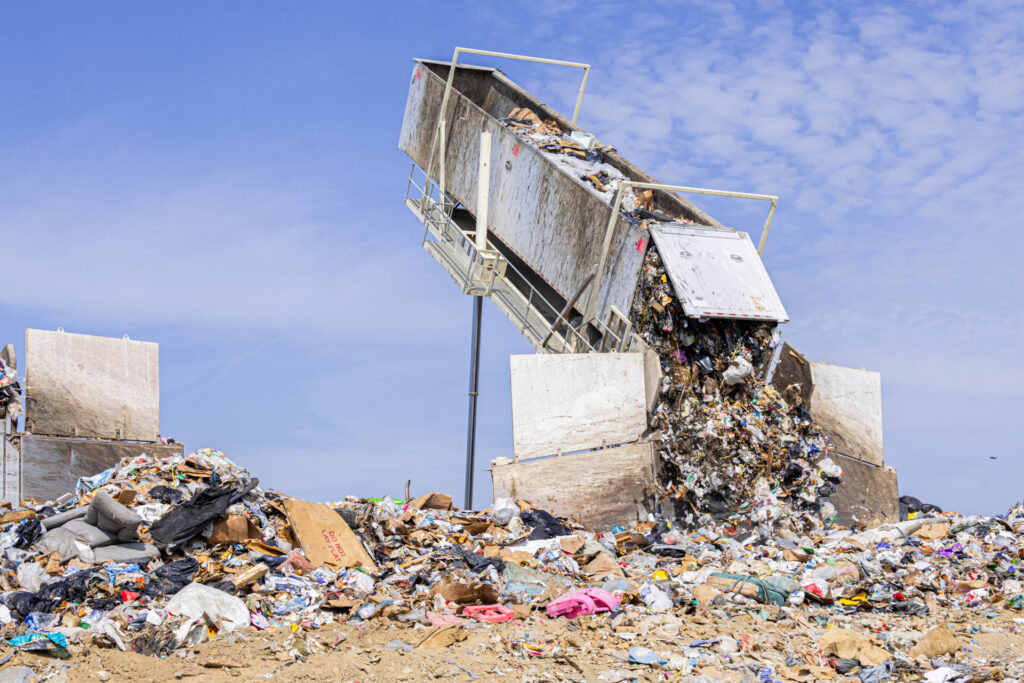
Across 41 communities in Central Ohio, 5,000 tons of waste from businesses and residents comes to the Franklin County Sanitary Landfill (FCSL) every day. But what happens to this waste after it is collected?
Each load goes across precision scale technology before being processed. Both routine and random inspections are performed on individual loads to confirm that they consist of only accepted materials.
Each truck that enters the landfill then unloads its waste on the active face. The active face is the designated area where waste is unloaded, so called because it is the face (or slope) of the landfill that is actively receiving waste. A variety of equipment can be found on the active face, including compactors and bulldozers. Water trucks are also used to control dust, and tippers to mechanically unload transfer trailers.
Once the waste has been deposited on the active face, it is compacted so it can take up as little air space as possible. This is done by bulldozers pushing the waste into thin lifts and compactors rolling over the waste. The FCSL measures its capacity in cubic yards of air space, and compaction is done to reduce the air space taken up by each layer of waste.
After the waste has been compacted for the day, it receives daily cover. EPA regulations currently require a minimum of 6 inches of cover, or OEPA approved equivalent alternate daily cover materials, to control odors and keep out pests and animal life. The day after, the daily cover is removed so new waste can be placed directly on the waste from the previous day. This ensures that all waste in the landfill is contained in one column.
The lifespan of a landfill is determined by calculating the volume for how much waste can go into its dedicated air space. The FCSL has a lifespan of around 40 years, and SWACO is making a concerted effort to extend that lifespan even further. Through bulldozing and compacting waste into thin layers to preserve the landfill’s airspace as well as promoting the diversion of recyclable and compostable materials, SWACO works every day to ensure that the residents, businesses and communities of Central Ohio will continue to have a safe and sanitary place for their waste to be processed long into the future.