

Rates
$39.75 per ton (Direct-Haul, In-District Solid Waste)
Tarps & Safety Vests
- All trucks and trailer loads must be fully tarped before entering any SWACO disposal facility.
- All customers must wear a vest on the landfill if they exit their vehicles.
For your convenience, high-visibility safety vests may be purchased at the FCSL Scale House for $5.00.
Untarped loads are subject to a $25 fee; for your convenience, tarps may be purchased at the FCSL Scale House for $10 (small tarp) or $15 (large tarp). To avoid the untarped load fee, vehicles must exit the FCSL, tarp their load, then re-enter.
What Type of Waste Is Accepted?
The FCSL accepts general solid waste, including furniture, carpeting, and general household trash. However, we urge you to reuse and donate or recycle as much as possible before bringing items to the landfill. We do not accept yard waste, liquids, or anything hazardous. For additional information regarding what is accepted at the Franklin County Sanitary Landfill, please call 614-871-5100.
About the Franklin County Sanitary Landfill (FCSL)

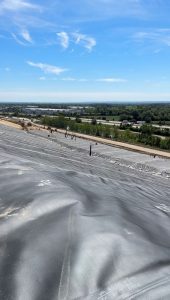 The Franklin County Sanitary Landfill (FCSL) is a municipal solid waste landfill designed to protect the environment and regulated by the Ohio Environmental Protection Agency. The landfill has served communities across central Ohio for more than 40 years and receives approximately 5,000 tons of waste a day. Every year, more than 1 million tons of waste is disposed of at the FCSL.
Construction of the landfill at 3851 London Groveport Road began in 1984, and the original footprint was established in 1985, giving SWACO a total of 116 acres. The FCSL's acreage has almost tripled in the years since, expanding to 334 acres.
The FCSL was originally built with four phases, which are the individual plots of land where waste is contained. Phases are now referred to as cells, and these cells measure around 20 acres each. The four original cells were constructed with an earthen clay liner to keep leachate, the liquid that forms when water passes through waste, from seeping into the ground. Liners have grown more sophisticated and effective since then because of improvements in technology and increased environmental regulations.
The FCSL has completed 11 landfill cells to date, with one additional cell currently under construction. The continued construction of these cells helps extend the landfill's lifespan and creates additional room to process new waste.
It was once thought that the landfill would reach capacity in 2000 because of regulations regarding the surrounding landscape at the time. However, through collaboration with the Ohio EPA, SWACO obtained a permit to build above ground, expanding the landfill's lifespan and allowing it to continue operating well into the future. SWACO received an additional expansion permit in 2017. The permit took effect in 2018, and site development for a new cell began in 2020.
Further technological advances continue to make the landfill safer and more efficient. These advancements include plastic and fabric geotextile liners, which are used to better contain leachate. Additionally, when landfill construction has used the last of the shredded tires available to line the sides of cells, SWACO will transition to using a conductive aggregate material instead. This material is already used on the cell floor and supports planned electric leak location surveys.
Landfill cap closures are required by the Ohio EPA and the U.S. Environmental Protection Agency. A cap closure is a final covering system installed on top of the landfill to help reduce greenhouse gas emissions and keep water out of the closed landfill area.
The cap closure system consists of a clay layer topped with a geomembrane, a drainage geocomposite material and 2.5 feet of protective soil finished with grass seed. This detailed process is important because it keeps out surface water, reduces leachate generation and increases landfill gas collection.
In 2024, SWACO completed the Franklin County Sanitary Landfill's first permanent cap closure, sealing a 16.2-acre section on the south slope of the landfill. The landfill remained fully operational throughout construction, and a new road was added to the south face of the landfill to improve hauler access to the top of the landfill.
Only one landfill cell has been permanently capped to date. When the landfill ultimately reaches capacity, it will be sealed and planted with grass and other vegetation.
The Franklin County Sanitary Landfill has an estimated remaining life expectancy of approximately 40 years. Through continued construction of new landfill cells and increased waste diversion through recycling, composting and waste reduction efforts, SWACO hopes to extend that lifespan even further. Throughout its history and into the future, the Franklin County Sanitary Landfill has been and will continue to be a valuable community resource.
For additional information on diversion please visit here and to tour the Franklin County Sanitary Landfill click here.
How does the Franklin County Sanitary Landfill benefit me?
The FCSL benefits the region by keeping costs low, operations transparent, and making the public's safety and the health of the environment top priorities.
How much life does the landfill have left?
The FCSL currently has about 40 years of life left. In 2018, SWACO received approval from the Ohio EPA for a new permit to install. The new permit will allow SWACO to:
- Add more than 30 years of landfill capacity on our existing property
- Ensure adequate landfill space remains available for area residents and businesses
- Provides access to safe and efficient disposal for nearly the next two generations