

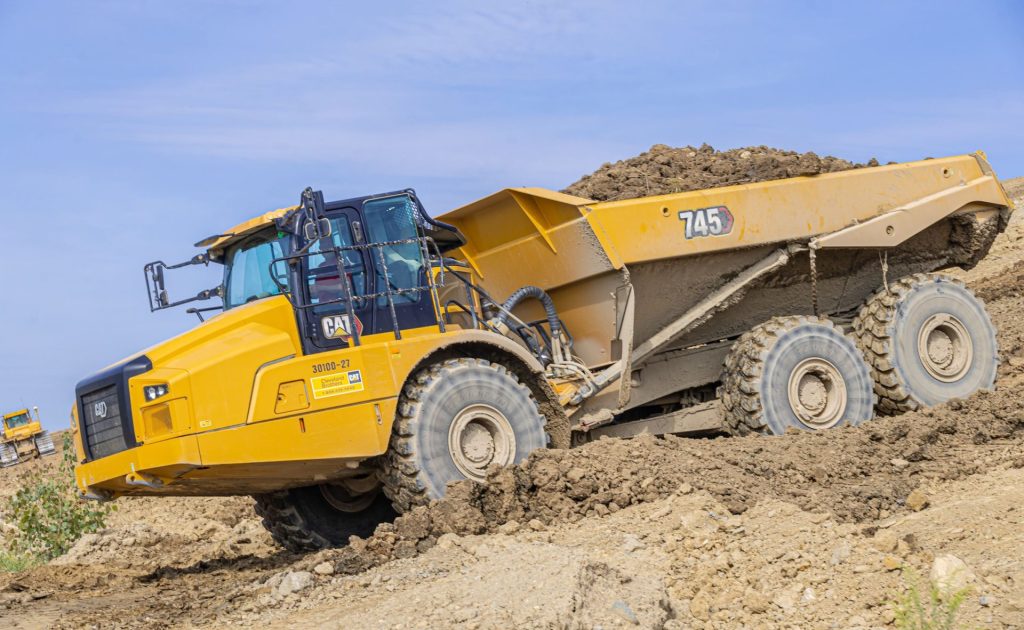
A tire has a beginning, a middle and an end. At the Franklin County Sanitary Landfill, that arc plays out across dozens of machines every year and what happens at the end of that lifecycle matters as much as what happens at the beginning.
The landfill’s heavy equipment fleet demands tires built for some of the most demanding conditions in the industry: steep grades, extreme loads and continuous use across a site that receives approximately 5,000 tons of municipal solid waste each day. Managing those tires responsibly from the moment they are mounted to the moment they are retired is a defined part of how SWACO operates.
The range of equipment on site requires tires across a wide spectrum. At the largest end are tires measuring 29.5R25 — large off-road tires found on graders, water trucks and dump trucks, engineered to bear enormous loads across terrain that would quickly destroy a standard commercial tire. On the smaller end, zero-turn mowers used to maintain the grass slopes across the FCSL run on tires as small as 7.5×14, while pickup trucks and light support vehicles use standard truck tires. Backhoes, excavators and fuel trucks fall in between. Each size category serves a different role and follows a different path at the end of its service life.
Heavy equipment tires at the landfill are not swapped on a fixed schedule. Like the equipment they support, they are tracked by wear, operating conditions and load history. The working surface of a landfill — uneven and constantly shifting — accelerates wear differently than pavement. SWACO’s in-house maintenance team monitors tires closely to determine when rotation, repair or replacement is needed. Staying ahead of tire condition is part of staying ahead of operational disruption: a failure on a landfill compactor or a fully loaded dump truck mid-shift creates risk for operators and can halt operations at a working face where thousands of tons of waste are waiting to be processed.
When a tire reaches the end of its service life, SWACO’s approach varies by size. Large off-road tires, including the 29.5R25s and comparable sizes from dump trucks and heavy haulers, do not all leave the site when they are retired. Their mass and durability make them practical dividers, and they are repurposed as traffic barriers along the working face of the landfill. Tires that cannot be reused as barriers are transported to Triple S Tire for proper disposal.
Smaller tires from pickup trucks, support vehicles and light equipment follow a different route. SWACO sends those tires to Liberty Tire Recycling in Columbus for proper processing. Liberty Tire operates facilities permitted and equipped to handle end-of-life tires in compliance with Ohio environmental regulations, converting them into materials used in new products rather like asphalt and commercial playgrounds than allowing them to accumulate as a disposal liability.
Ohio classifies waste tires as a special waste category. Stockpiled tires collect standing water and do not compact efficiently in a landfill. When ignited, they can burn for days, releasing pollutants that are difficult to control. By reusing large tires on site and routing smaller ones to a certified recycler, SWACO keeps this material out of the landfill’s waste cells, reserving that space for what it is designed to receive.
Tires are a small part of what SWACO manages each day, but the thinking behind them reflects something larger. The same discipline applied to the region’s waste stream applies to the tools used to manage it. From the first shift to the last, every tire at the Franklin County Sanitary Landfill has a plan.
Residents can put that same thinking to work for their own tires by visiting SWACO’s Recycling Convenience Center at 2566 Jackson Pike in Columbus, a facility designed to help residents properly recycle hard-to-recycle materials, including tires.