

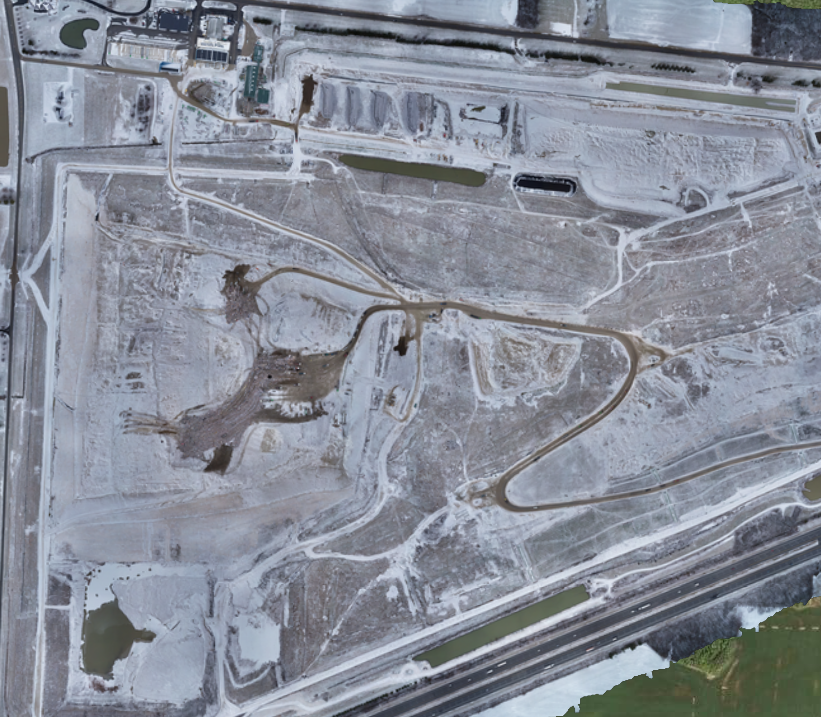
When Franklin County reaches a Level 3 snow emergency and flakes pile up across central Ohio, most residents think about slick roads and school closures. At the Franklin County Sanitary Landfill (FCSL), the focus shifts to something less visible but equally important: what that precipitation means for the millions of gallons of water moving through the site each year.
Snow is far more than a seasonal inconvenience. It is a critical part of the water cycle that SWACO’s environmental and operations teams monitor year-round. Central Ohio averages 42.8 inches of precipitation annually, and every inch of rainfall and every melting snowflake must be carefully managed. Understanding where that water goes is central to how FCSL protects the surrounding community and the natural environment.
At the landfill, the most important question in water management is simple: did the water come into contact with waste? The answer determines how the water is handled.
Precipitation that flows across the landfill without touching waste, whether from rain, snowmelt or ice thaw, is directed to one of four on-site sediment ponds. This is accomplished through a system of vegetated earthen berms, geomembrane liners, stone channels and HydroTurf, a high-performance erosion control surface installed on capped areas of the landfill. These systems, often referred to as downchutes or stormwater letdowns, move surface runoff away from active waste areas and into controlled containment. Water collected in the sediment ponds undergoes strict oversight, including daily visual inspections and monthly chemical sampling, before it is discharged to the waters of the state. Each release must meet applicable regulatory standards.
Water that does come into contact with waste follows a different path. It is reclassified as leachate, the liquid produced when precipitation filters through solid waste and collects dissolved and other contaminants. Managing leachate requires specialized infrastructure and continuous monitoring. Heavy rainfall and significant snowmelt events directly increase leachate volumes at FCSL. As more water infiltrates the waste, the landfill’s leachate collection system works to capture and convey that liquid.
On average, SWACO manages approximately 26 million gallons of leachate each year, a volume that reflects both the size of the facility and the region’s precipitation patterns.
Seasonal changes play a role as well. Spring snowmelt can create noticeable spikes in leachate generation as months of accumulated snow release water over a short period. SWACO prepares for these fluctuations by operating systems designed with surge capacity and by monitoring conditions continuously throughout the year.
Once collected, leachate is briefly stored in a dedicated on-site lagoon before being pumped directly to the Southerly Wastewater Treatment Plant (Southerly), operated by the City of Columbus. This direct pipeline connection provides a significant operational advantage. Instead of relying on off-site hauling, SWACO can pump leachate continuously, reducing on-site storage demands and minimizing the potential for odor. Pumping leachate directly to Southerly saves Franklin County residents money, as it is more cost-effective than hauling.
Southerly is one of the largest wastewater treatment plants in Ohio and is fully equipped to treat landfill leachate.To track leachate strength relative to typical domestic wastewater, SWACO conducts regular testing, including measurements of biochemical oxygen demand (BOD), an indicator of organic load. Landfill leachate typically has a much higher BOD concentration than household wastewater, underscoring the complexity of the material being treated.
Routine inspections and monitoring ensure all stormwater and leachate systems remain compliant and responsive, regardless of weather conditions.
The next time a winter storm moves through Franklin County, it is worth considering the work happening behind the scenes at FCSL. Every inch of snow that falls on the landfill is precipitation that must be tracked, managed and treated appropriately.
Through high-engineered infrastructure, rigorous oversight and a longstanding partnership with the City of Columbus, SWACO manages approximately 26 million gallons of leachate each year with a focus on environmental protection and community responsibility. It is a reminder that effective landfill management extends far beyond waste itself, and that even a central Ohio snowstorm plays a role in the process.