

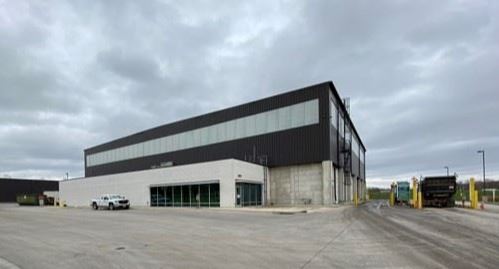
All municipal solid waste generated within Franklin County is disposed of at the Franklin County Sanitary Landfill in Grove City. Transporting waste from collection routes across the county to the landfill, however, requires strategic infrastructure designed to maximize efficiency and minimize environmental impacts. That is where SWACO’s transfer stations play an important role.
Transfer stations serve as intermediate collection points where waste haulers can deposit municipal solid waste before it is transported to the landfill. SWACO owns and operates two transfer stations, located at 2566 Jackson Pike and 4262 Morse Road. Both facilities are strategically located to serve the City of Columbus and other account customers throughout the region.
These facilities support the county’s waste management system by allowing haulers to continue their collection routes more efficiently, without the time and fuel expense of traveling to Grove City after each full load. Instead of making multiple trips to the landfill, haulers can deliver waste to the nearest transfer station and return to service with less travel and downtime. SWACO then stacks and loads the material and transports it to the Franklin County Sanitary Landfill in larger, more efficient loads using semi-trailers.
SWACO’s transfer stations handle large volumes of municipal solid waste. On average, the two facilities receive a combined total of approximately 800 to 1,200 tons of waste per day. With the Morse Road facility currently closed to private haulers during construction, that location is receiving approximately 400 to 600 tons per day, while the Jackson Pike facility continues to operate at full capacity.
The transfer stations are equipped with a range of specialized equipment designed to support efficient and safe operations. Electric-powered material handlers are used primarily inside the transfer buildings to move and manage waste. Their electric operation reduces emissions, lowers noise levels and supports a cleaner indoor work environment while maintaining strong lifting and handling performance. Diesel-powered material handlers provide similar capabilities and are used where diesel power is more practical. Front-end loaders are used to push, stack and load waste efficiently, supporting material flow throughout the facility, particularly during peak volumes. Street sweepers are also used throughout the sites to maintain clean roadways and operating areas, ensuring safe and orderly operations.
The Morse Road transfer station is currently undergoing a construction project designed to enhance operational efficiency, with a focus on improving the transportation of waste between the transfer station and the Franklin County Sanitary Landfill. Construction improvements at the Morse Road facility are expected to be completed in May 2026.
Two major components of the project include a new transfer station floor and the installation of a pre-load compactor system. The new floor improves safety and efficiency by providing a smooth, level surface that allows equipment to operate more effectively. It reduces wear and tear on machinery, minimizes hazards for employees and improves material flow throughout the facility, while also enhancing housekeeping capabilities and long-term reliability and reducing maintenance needs and operational downtime.
The pre-load compactor system compresses waste into dense loads before transferring it directly into transfer trailers. The system produces loads of approximately 34 tons, which are injected into trailers for transport. This technology improves loading and hauling efficiency, reduces the number of trips required between the transfer station and the landfill, and lowers transportation costs. Fewer trips also result in reduced fuel consumption, lower emissions and decreased wear on vehicles and roadways.
Transfer stations are essential infrastructure supporting waste management across central Ohio. By strategically locating these facilities and investing in advanced equipment and operational improvements, SWACO ensures municipal solid waste is managed efficiently, safely and sustainably. As the region continues to grow, SWACO’s transfer stations will remain vital assets in managing waste responsibly while supporting the haulers and communities that depend on them.