

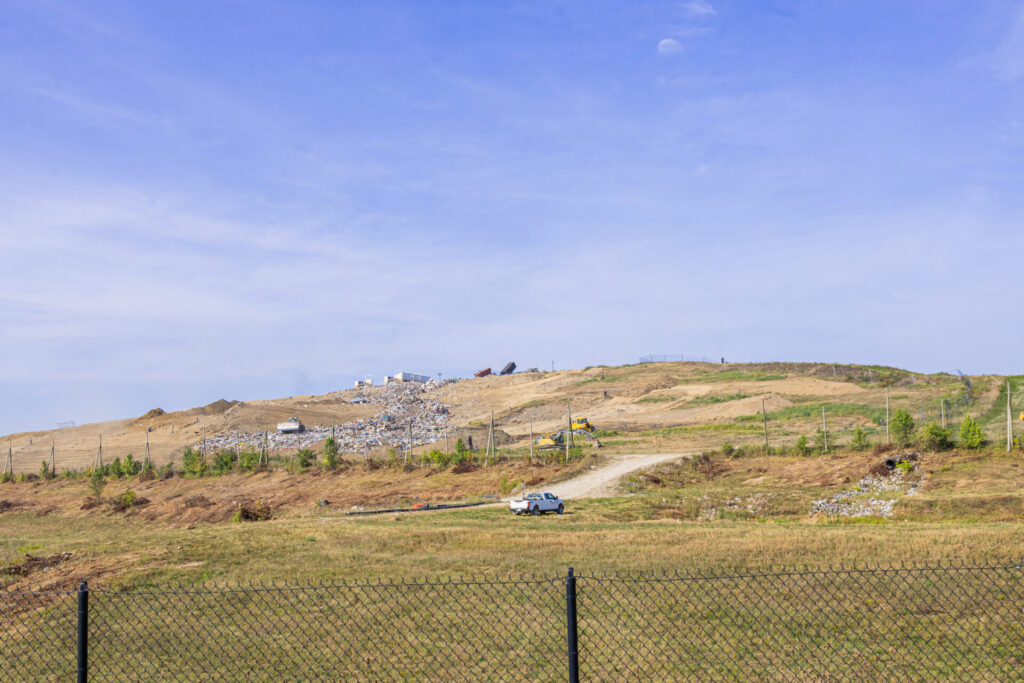
One of the most essential duties of a sanitary landfill is containing waste in a way that does not compromise the health of the surrounding environment. Sanitary landfills have developed a variety of methods to achieve this, addressing concerns from leachate accumulation to greenhouse gas pollution. SWACO contains the waste that enters the Franklin County Sanitary Landfill (FCSL) in intentionally constructed cells, using several thick layers of material as a highly fortified barrier between the waste and the soil.
One of the ways SWACO works to sanitize the FCSL is the use of installed fencing to contain litter that may be moved around by the wind. These 30-foot-tall, portable litter fences catch waste from neighboring cells and can be moved as needed. This helps staff easily collect escaped waste and return it to the appropriate cell.
Typical gases emitted by decomposing waste are 50-60% methane and 40-50% carbon dioxide. The FCSL has approximately 300 wells drilled directly into the waste column to collect this gas as waste decomposes, protecting the surrounding air from greenhouse gas pollution.
Inside each landfill cell is a complex leachate collection system. As leachate percolates through the cell, gravity brings it down into a centralized sump. A transducer reads how much liquid has collected in this sump, and when the leachate accumulates, it is pumped out of the cell into a pipe network called a force main. The force main leads directly to the Southerly Wastewater Treatment Plant eight miles away from the landfill. Additionally, the FCSL has installed padding on the inside of individual pipes to prevent the buildup of residual materials.
When a landfill cell has reached capacity, the final step is sealing it off. This is done to ensure that surface water does not reach the waste, reducing the formation of leachate. First, a recompacted soil barrier is installed, measuring 1.5 feet thick. An artificial geomembrane is installed on top of the soil barrier. Next, a geocomposite drainage layer is then installed atop the geomembrane, followed by a final 2.5-foot protective soil layer to complete the cap. Each layer helps ensure the waste beneath the cap closure is sealed as thoroughly as possible.
From leachate collection to landfill gas management, SWACO uses a range of systems and practices to responsibly manage waste and protect the environment at the FCSL. By following industry best practices and environmental regulations, the organization works to ensure the landfill continues to serve the community safely and responsibly.